

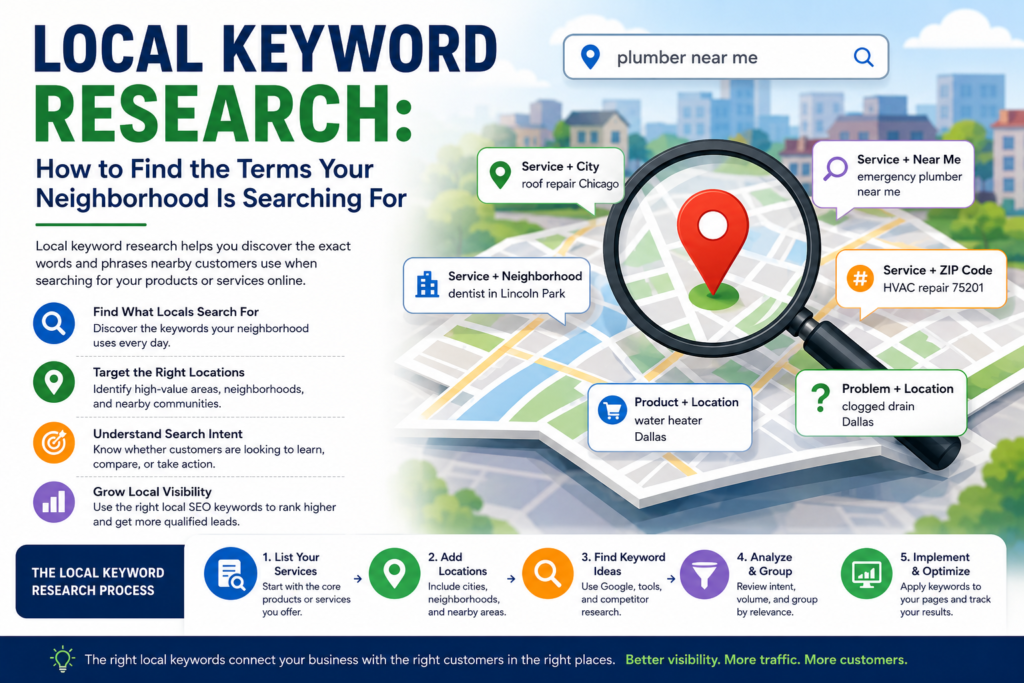
Local keyword research helps you find the words and phrases people use when searching for businesses, services, or products in a specific area. These searches may include a city, neighborhood, ZIP code, or terms such as “near me.”
For a local business, the goal is not simply to find keywords with the highest search volume. You need to know what nearby customers search for, how they describe their needs, and which searches are likely to lead to calls, visits, appointments, or sales.
A plumber may describe a service as “residential drain cleaning,” while customers may search for “clogged drain plumber near me.” Local keyword research helps uncover these differences.
What Is Local Keyword Research?
Local keyword research is the process of identifying search terms that connect a service or product with a specific geographic area.
These keywords can be used to plan service pages, location pages, Google Business Profile optimization, blog posts, and other local SEO work.
Common local keyword patterns include:
- Service + city
- Service + neighborhood
- Service + “near me”
- Service + ZIP code
- Service + county
- Problem + location
- Product + location
For example, a roofing company might find searches such as “roof repair Chicago,” “emergency roofer near me,” and “roof replacement Lincoln Park.”
Each search relates to roofing, but the location and customer intent are different.
Why Does Local Keyword Research Matter?
Local businesses do not need traffic from every searcher. They need visibility among people who can realistically become customers.
A dentist in Toronto, for example, may get more value from someone searching “emergency dentist Toronto” than from a broad dental keyword searched by people across the country.
Good local SEO keywords can help determine:
- Which services need dedicated pages
- Which locations are worth targeting
- What terms should appear on service pages
- Which blog topics customers are interested in
- What people search before contacting a business
- How customers describe specific services or problems
Keyword research also helps prevent businesses from building pages around industry terminology that customers rarely use.
What Is Local Search Intent?
Local search intent means the searcher expects results connected to a particular geographic area.
The wording of a query can tell you a lot about what the person wants.
| Search Query | Likely Intent | Best Content Type |
|---|---|---|
| How to fix a leaking pipe | Informational | Blog or guide |
| Plumber near me | Local / Transactional | Google Maps + service page |
| Emergency plumber Dallas | Local / High intent | Service page |
| How much does a plumber cost? | Informational / Commercial | Guide or service content |
| Drain cleaning company Dallas | Local / Commercial | Service page |
Search results can also help identify intent.
If Google mainly shows business listings, Google Maps results, and service pages, the query probably has strong local commercial intent.
If the results mainly contain guides and articles, informational content may be a better fit.
How Do You Find Local Keywords for Your Business?
A good local keyword research process starts with the services you actually provide and then adds the language and locations customers use.
1. Start With Your Main Services
List the services that customers can actually hire your business to provide.
An HVAC company might start with:
- AC repair
- Furnace repair
- HVAC installation
- Air conditioning maintenance
- Emergency HVAC repair
Do not add locations yet. First identify the core services that generate business.
2. Add Relevant Locations
Next, combine your services with the areas you serve.
These may include:
- Cities
- Neighborhoods
- Counties
- Districts
- Nearby communities
- ZIP codes
For example:
AC repair → AC repair Dallas → AC repair North Dallas
Only target areas the business actually serves. There is little value in creating pages for locations where the company cannot realistically serve customers.
3. Research “Near Me” Searches
People frequently search for nearby businesses using phrases such as:
- Emergency dentist near me
- Roofing company near me
- Auto repair shop nearby
- Family lawyer near me
You do not need to repeatedly place “near me” throughout your website.
Instead, make your business location, service area, services, and contact details clear. These details help search engines connect the business with nearby searches.
4. Check Google Search Suggestions
Google’s search suggestions can provide useful ideas about the language people use.
Start typing a service and location into Google and review the suggestions that appear.
You may find searches related to:
- Prices
- Emergency services
- Specific problems
- Neighborhoods
- Availability
- Types of services
- Business categories
Related searches can also help identify additional keyword variations.
Not every suggestion needs its own page. Use them to understand what people are searching for.
5. Review Local Competitors
Search your main services and look at the businesses that consistently appear.
Review their:
- Service pages
- Location pages
- Page titles
- Website navigation
- Google Business Profile categories
- FAQ topics
- Blog content
Competitor research is useful for finding topics or services you may have missed. The goal is not to copy another website.
6. Use Keyword Research Tools
Keyword research tools can help expand your list and provide information such as:
- Estimated search volume
- Related keywords
- Keyword difficulty
- Competition
- Geographic search data
Do not automatically reject a keyword because it has low search volume.
Local searches naturally have smaller audiences. A keyword with 30 highly relevant searches in your service area may be more useful than a broad keyword with thousands of searches from people you cannot serve.
What Is Hyper-Local SEO?
Hyper-local SEO focuses on smaller geographic areas such as neighborhoods, districts, or communities rather than an entire city or region.
Examples include:
- Personal injury lawyer Brooklyn Heights
- Dentist Upper East Side
- Plumber Lincoln Park Chicago
- Restaurant Downtown Toronto
Hyper-local targeting can be useful in large cities where customers often search by neighborhood.
Should You Target Neighborhood Keywords?
Target neighborhood keywords when two conditions are met:
You actually serve the neighborhood, and people have a reason to search using that location.
Avoid creating dozens of nearly identical pages where only the neighborhood name changes.
A neighborhood page should provide useful information for customers in that particular area.
How Should You Organize Local SEO Keywords?
Finding hundreds of keywords is not the goal. The next step is grouping related terms based on their intent.
| Keyword Group | Example Keyword | Recommended Page |
| Core Service | Plumbing services Dallas | Main service page |
| Specific Service | Drain cleaning Dallas | Drain cleaning page |
| Location | Plumber Fort Worth | Location page |
| Emergency | Emergency plumber Dallas | Emergency service page |
| Informational | Why does my drain keep clogging? | Blog post |
Several keywords with the same meaning can usually be targeted on one page.
For example:
- Plumber Dallas
- Dallas plumber
- Plumbing company Dallas
- Plumbing services Dallas
These phrases may have slightly different wording, but they often represent similar search intent.
Creating four nearly identical pages is usually unnecessary.
What Makes a Good Local Keyword?
The best keywords for local businesses are not always the ones with the largest search volume.
A useful local keyword should:
- Describe a real service or product
- Match an area the business serves
- Reflect what potential customers search for
- Match the purpose of the page
- Have a reasonable connection to leads or sales
Consider the difference between:
“plumbing”
and
“emergency drain cleaning Dallas.”
The first keyword is broad. The second gives you information about the service, location, and immediate need of the searcher.
Commercial relevance should be considered alongside search volume.
What Local Keyword Research Mistakes Should You Avoid?
Targeting Every Nearby City
More location keywords do not automatically mean more local traffic.
Focus on areas the business actually serves and where attracting customers makes sense.
Creating a Page for Every Keyword
Closely related keywords often belong on the same page.
“Dallas plumber” and “plumbing company Dallas” usually do not require separate landing pages.
Ignoring Search Intent
Match the page to what the searcher wants.
A service page is usually better for someone looking to hire a business. A blog post is usually better for someone looking for an explanation or instructions.
Choosing Keywords Only by Search Volume
High search volume does not always mean high business value.
A neighborhood-specific service keyword may receive fewer searches but bring visitors who are much closer to becoming customers.
How Does Local Keyword Research Support Local SEO?
Good local keyword research gives your SEO work direction.
It can help you decide:
- Which services need pages
- Which locations should be targeted
- Which questions deserve blog posts
- How pages should be internally linked
- Which terms match commercial intent
- Where Google Business Profile optimization fits
For example, keyword research might show that customers search separately for AC repair, furnace repair, and HVAC installation. Instead of placing everything on one general HVAC page, the business may benefit from dedicated pages for those services.
That creates clearer paths for both search engines and customers.
How Can Rank Your Site Help With Local Keyword Research?
Rank Your Site provides Local SEO services for businesses that want to reach customers in the areas they serve.
Local SEO work can include keyword research, Google Business Profile optimization, service and location page planning, competitor research, citations, website optimization, and content planning.
The goal of local keyword research is not to attach city names to hundreds of keywords. It is to find the searches where the right service, location, and customer need overlap.
Frequently Asked Questions About Local Keyword Research
What Are Local SEO Keywords?
Local SEO keywords are search terms connected to a geographic area or local need. Examples include “dentist Boston,” “plumber near me,” and “roof repair Toronto.”
How Do I Find Keywords for a Local Business?
Start with your main services, add the locations you serve, check Google suggestions, study competitors, review customer language, and use keyword research tools to expand the list.
Should I Target “Near Me” Keywords?
You should research “near me” searches, but you do not need to repeatedly add the phrase to website copy. Clear business location, service area, website, and Google Business Profile information can help search engines understand where the business operates.
Are Low-Volume Local Keywords Worth Targeting?
Yes, when they closely match a valuable service and the area you serve. A smaller number of highly relevant searches can have more business value than a broad keyword with much higher traffic.
What Is the Difference Between Local SEO and Hyper-Local SEO?
Local SEO may target an entire city or service area. Hyper-local SEO narrows the focus to smaller geographic areas such as neighborhoods, districts, or communities.
Find the Local Searches That Matter to Your Business
Local keyword research should start with customer behavior rather than search volume alone.
Find out what people need, how they describe it, where they are searching, and what type of page best answers that search.
Once your local SEO keywords are grouped by service, location, and intent, they can guide your service pages, location pages, Google Business Profile work, blog content, and internal linking.
